Showing posts with label emergent literacy. Show all posts

Thursday, November 29, 2012

Integrating reading &writing:Print rich environment

I love having words around for my children to read. This as an easy craft I did in the Fall.
1. Get letters from your local craft store.
2. Choose scrapbook paper. 
3. Turn letters over to trace
4. Cut out letter.
5. Use modge podge on the letter and stick paper to the letter.
6. Place a bit of mode lodge on top of the paper. Allow to dry and hang where you would like. 

I have also done this for the girls names. 


Tuesday, October 23, 2012

Integrating Holidays: Halloween Fun

This time of year is very long for parents, at least for me. Every day I get the question, when is Halloween? In schools they talk about Fall and Halloween for quite a while.

A favorite book to read:


To help with sequencing and comprehension skills, you can:
 enlarge items from the book, color them, lamenate them (for durability), and have your child put them in order of how they arrived in the story.

We read the book then I had her put them in order from what she remembered. After that, we checked the book to see what she got correct.
Once they were all in order, we made the noises of the two shoes going "clomp, clomp" and the other noises as well.

It was a fun activity and one we can revisit again and again. After a while, I am going to see if she can draw the items in order and create her own scarecrow.


Here is a link with tons of Old Lady activities for this book: Afraid of anything


Also fun Fall activities remember Leaf Man from a previous year?

Thursday, July 28, 2011

Integrating Phonics: Now I know my ABC's

In just a few weeks, school will begin. Some children are beginning school for the first time. One thing that teachers love for Kindergarten students to understand is the alphabet. Even though children need to recognize the letters of the alphabet for first and second grade reading achievement, children do not need to know all of the letters in any particular order before they begin learning to read or write.
Dorothy Strickland in "Teaching Phonics Today: Word Study Strategies Through the Grades," states, “The best practice is to help children identify letters and numbers in an enjoyable way as they acquire the broader concepts about print and books they will need as a foundation for literacy:
-Focus on letters that have special meaning for children, such as the letters in their own names.
-Teach the alphabet song
-Read alphabet books on a regular basis and make them available for children to look at on their own.
-Make simple picture dictionaries available.
-Help children make an individual alphabet book.

For older children struggling readers, the same general phonics principals apply for teaching older grades. Application is key. You have to model and do things that are age appropriate. When students learn bad reading habits by the 4th grade, modeling is important to reteach.

Of course, if you google ABC books, you get 9,000,000, but here are a few of my favorite.
This is a wonderful transfer to begin to look for letters in the world around you.
What kindergartener, first, or second grader doesn't know the song that goes with this story? I am sure that your child has or will come home with a tree and the letters of his/her name on the side.
Another great transfer to find items that begin with a certain letter each day.
As you focus on a letter of the day, why not eat a fruit or vegetable that begins with that letter?
She has become one of my favorite baby authors. (From The Going to bed board book).


Many of these authors are getting smart and making them into board books as well as regular books. My 2 1/2 year old reads from both. I teach her early on how to handle and treat books. Don't be afraid to start buying paper back books for your toddlers. Read those to them and put them in a magazine holder up high and keep the board books for their "reading time" alone.

Reference: IRA-www.reading.org

Wednesday, April 20, 2011

Integrating Reading all day: Emergent literacy

Do you want to excite your child about reading? Get them excited when they see letters that are in their name? When they ask to watch TV, you answer, read a book instead, and they are fine and know just which books to read? I know this sounds easy, but surround them with print all day long.

Just like most parents, I thought about buying "Your baby can read," and then I realized, I could do that myself in the re-reading of books, and making flashcards of the words she began to sign as an infant.Saving tons of money. So since infancy, I have added more and more words to those rings. The words she signed first are still on there, but the words she uses the most are on there. Incuding her name.

Everywhere my daughter goes, there is print in her life.


My daughter spelled her name to the family a few months ago. The E and L run together when she is saying it fast, but she spells it nonetheless. I knew her life was print rich when I was cleaning the bathroom and she called to me, "mommy, I spelled my name." When I went to see what she was talking about, tears came to my eyes. She did this on her own. I was so proud of my two year old.


You too, can make a print rich environment. It all starts with a pen and some paper. Look around your home and see where you can place the words on the paper. Good luck!

Sunday, April 3, 2011

Integrating Holidays: Rhyming word eggs

Ever wonder what you can do with all of those plastic eggs you buy? Turn a few of them that don't make the Easter Basket into rhyming words for those emergent readers.
1.Pick words with an initial letter that would go with the ending. Use words that your child might be learning in school. Ran Rat Fat Fan Big Pig
2.Put the word families on the same color eggs.
3. I used the larger and smaller eggs. Once the eggs are placed together, have your child put the smaller eggs that goes with the family inside.
Enjoy!
FYI-You can clean off the marker with nail polish remover.

Sunday, March 6, 2011

Integrating Art: Emergent Literacy with Crayola

Introducing art to infants and toddlers allows them to explore the world around them.

In our area, one way I began to introduce art was to take advantage of the free first Wednesdays of the month they have at the Art Museum. (They even have one at the History of Natural Museum). It has been nice to go for a little bit at a time as her attention span has increased, we have stayed longer and longer.

After you have exposed your child, allow them to create:
1. Find some great books to read.
2. Invest in Crayola finger paint, Crayola mess free color wonder, or the good old fashioned crayons.
3. Find a study easel (I found mine at Ikea)
4. Of course, a bib to cover up.

Books:


I found this easel at Ikea:

The bibs also from Ikea.

The result, a long creative train of artwork. She walked her art back and forth for a half and hour. Who knew it would turn into that. The nice thing about taking pictures is you can see the growth in strokes and maturity of creative vision.


I will take pictures of all of her art to turn into a book by using snapfish or shutterfly so that paper doesn't clutter the home and she gets to keep her artwork.

Sunday, February 6, 2011

Integrating writing: Journals

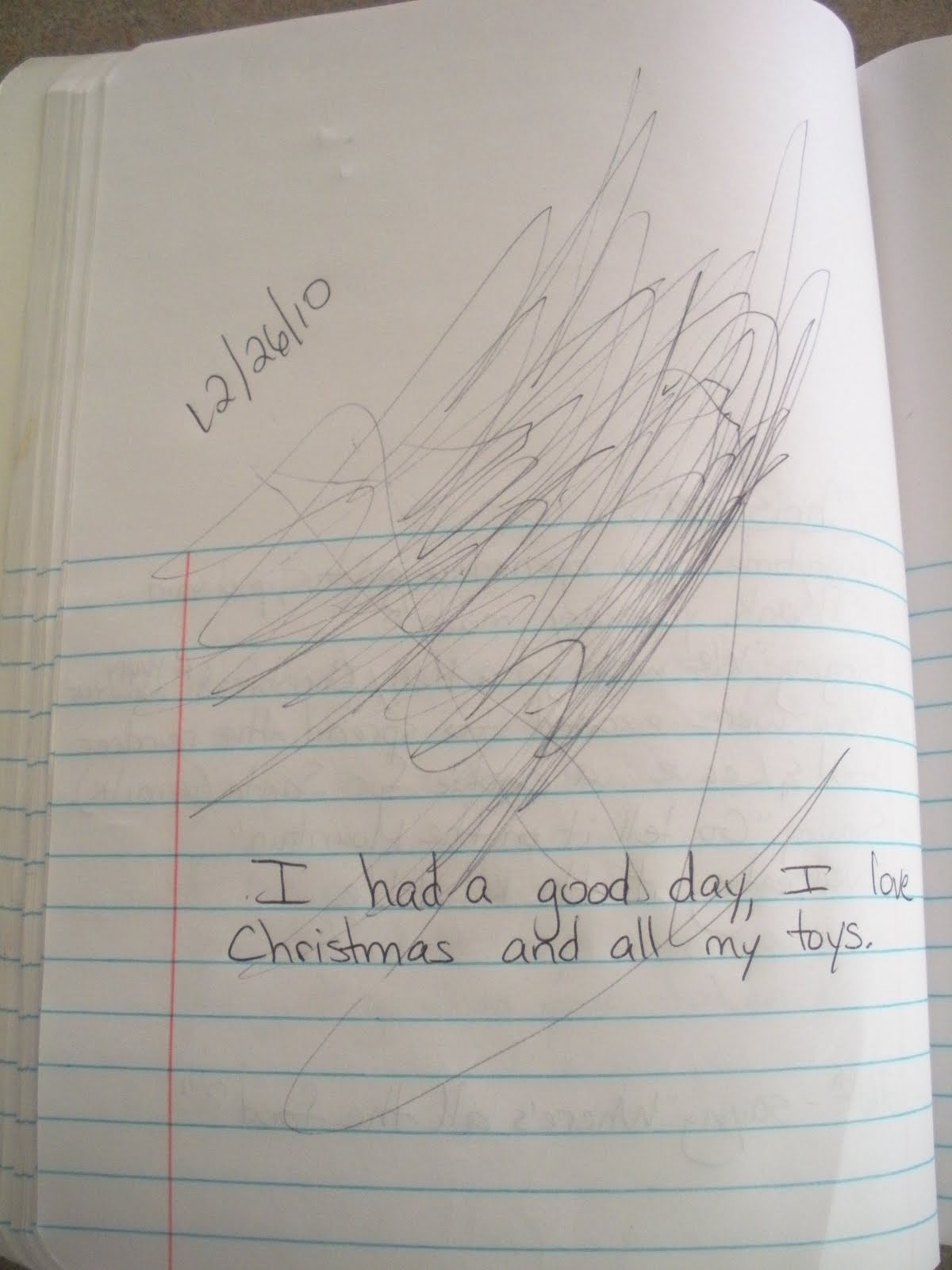
I have always written in a journal. I regret throwing my early ones away. Now that I have children, I get them to write as often as I can. During the summer, I have my children reflect on the activities they did that week. It is fun and it keeps their writing going as well.

But how early, is too early? The minute a child can pick up and hold a pencil to make a line. I have a journal that I write in each month for our youngest daughter. As she makes milestones, I enter them in the journal. Each month, I have her "write" on the top of the page. We have been doing this for a year. (She is two). I am excited about the progress and growth of her lines. She makes circles thanks to my dad teaching her and other things. She asks me how to spell her name and she will put it on the paper as she "writes" it. The past few months, I have been writing the actual phrase she is saying underneath and as time goes on, I won't be surprised to see letters form. She watches me write everyday, and I know that has a big effect her her writing.


For more information about Early Writing Development, click here: Early Writing Development.

Integrating Art: The Sock Puppet

My 2-year old is always putting her socks on her hands. So, when I was getting ready to throw away my worn out, hole filled socks, an idea struck me. Sock puppets!!

We got out the hot glue and found whatever pieces we could and this is what we made:


Nothing spectacular or art-tastic, but to my daughter, it is amazing. And it should be, she created it. What is even more amazing is the good listening ears my daughter gave that sock puppet. She tried to put him on her arm and when the sock was there she said , "It's not working." Man, to be a child again.

So, sock puppet, continue to do your magic. Read, read, read.

Monday, January 3, 2011

Integrating facts: Parent Involvement

Parents need to start to read to their child right away. Starting in infancy when the baby is alert and the parent is not distracted will bridge the baby's desire to communicate. Parents can also model the use of literacy in the home by having reading and writing materials available for the child and to talk about various topics in the home.

Parents can make reading aloud part of a routine and be a good model for reading. When the home is filled with books, parents will establish good reading habits and read themselves. When children see their parents read, they are better able to engage in book literacy and maintain reading interest through developing years.

Reading with the baby is called emergent literacy. Enjoy finding all the fun baby books and of course because they are only small for a while, use your local library!